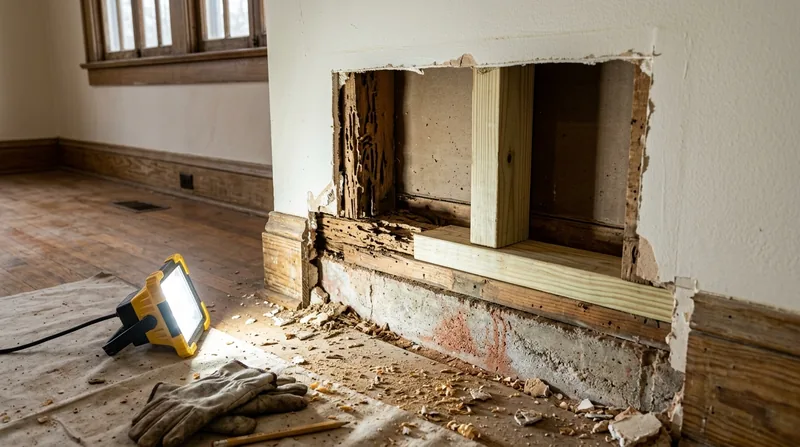




Greensboro's historic neighborhoods, from the grand Craftsman bungalows of Fisher Park to the Colonial Revival homes of Old Irving Park, were built with heart-pine framing and original wood trim that stands as a permanent draw for subterranean termites. The Piedmont's dense, iron-rich red clay and humid subtropical climate create ideal conditions for these wood-destroying insects to thrive in the foundation zones and lower framing of century-old homes. Once a pest inspector confirms an infestation and the exterminator completes treatment, the damaged wood remains, and that is where termite damage repair in Greensboro begins. We remove and replace compromised studs, sill plates, subfloor sections, and trim, working directly from your inspection report to restore structural integrity and prevent further decay. Whether the damage is localized to a corner of a rim joist or extends through multiple floor joists, we assess what can be repaired and what must be replaced, then execute the work with the same crew from start to finish.
Why Termite Damage Matters in Greensboro's Historic Homes
Subterranean termites do not simply vanish after treatment. They leave behind hollowed studs, weakened floor joists, and compromised sill plates that will continue to fail under the weight of your home and the constant moisture that seeps through Greensboro's red clay soils. Left unrepaired, damaged framing can lead to uneven floors, soft spots in subfloors, and accelerated decay in adjacent wood members. The longer damaged wood sits, the more secondary damage spreads, and the more expensive the final repair becomes. In historic neighborhoods like Westerwood and Aycock, where homes are tightly spaced and original framing is the rule, early intervention saves both your home's structural integrity and your wallet.
- We remove all wood that termites have hollowed or structurally compromised.
- We replace damaged sections with pressure-treated lumber or heartwood species matched to the original material where finish appearance matters.
- We sister new joists to existing members when the original wood can support additional load and repair is more honest than replacement.
- We document the scope and materials used so you can file for insurance coverage if your policy covers insect damage.
- We verify all work against the Greensboro building department's requirements for structural repairs.
Once the repair is complete, the structural risk is gone, and your home's framing is sound again.
Key info: A typical termite damage repair in a Fisher Park bungalow might involve replacing 4 to 6 linear feet of rim joist, sistering a compromised floor joist, and patching subfloor sections. We work from your pest inspector's report, which identifies exactly where the damage is located and how deep it extends. See our wood rot repair page for more on structural wood assessment.
How We Repair Termite Damage: Our Process in Greensboro
We begin with a site visit to examine the scope of damage against your inspection report. We confirm which wood members are load-bearing, which can be repaired by sistering, and which must be cut out and replaced entirely. We then develop a clear repair plan, obtain any required permits from the Greensboro building department for structural work, and schedule the job. Our crew removes the damaged sections, installs appropriate temporary support where needed, and replaces the wood with materials that match the original species and grade whenever finish appearance is a factor.
- We inspect the damage zone and measure the extent of hollowing and structural loss.
- We obtain a permit if the repair involves a load-bearing wall, primary floor joist, or sill plate.
- We remove all compromised wood and dispose of it properly.
- We install new lumber, sistering joists where the original wood can share the load, or replacing sections entirely where damage is too severe.
- We seal cut wood ends and apply finish to match the original trim or paint scheme.
- We provide a detailed invoice and photo documentation for your insurance file.
The entire process typically takes 2 to 5 days depending on access, the number of members involved, and permit timelines.
Local example: A homeowner in Guilford Hills discovered termite damage in the sill plate and band joist of a 1960s ranch home. Our crew removed 8 linear feet of compromised sill, installed a new pressure-treated sill plate with proper bearing on the foundation, sistered a floor joist that had lost 30 percent of its depth, and replaced a 4-by-8 section of subfloor. The job took 3 days and cost within the $2,400 to $3,200 range. See our floor joist and subfloor repair page for more detail on these common repairs.
Termite Damage Repair Methods and Materials
| Approach | Description | Best for |
|---|---|---|
| Full Member Replacement | Cut out the entire joist, stud, or sill plate and install new pressure-treated or matched heartwood lumber. | Damage that removes more than 25 percent of a member's cross-section, or damage in load-bearing sill plates and primary joists. |
| Sistering | Install a new joist alongside the damaged one, bolting or nailing them together to share the load. | Joists that have lost 15 to 25 percent of depth and can structurally support shared loading with a sister member. |
| Localized Patch | Cut out the damaged section of a rim joist or band board and splice in new pressure-treated lumber with bolted connections. | Damage confined to 2 to 4 linear feet of a rim joist or band board that does not compromise the primary load path. |
| Subfloor Replacement | Remove soft or hollow subfloor sections and install new plywood or boards, securing to the joists below. | Subfloor damage that creates soft spots or voids, often discovered during floor joist repair work. |
Termite Damage Repair Cost in Greensboro: What to Expect
Termite damage repair costs in Greensboro typically start at $1,200 for a small, localized repair such as a 4-foot section of rim joist or a single sistered floor joist. Most residential jobs involving multiple members, subfloor work, or complex access fall into the $2,400 to $4,500 range. Larger repairs that involve extensive joist replacement, multiple sill plate sections, or structural complications can exceed $5,000. The primary factors that move cost upward are the number of members involved, the linear footage of damage, access difficulty, permit requirements, and whether the original wood must be matched for finish appearance.
We recommend getting 2 to 3 estimates from local carpenters who will inspect the damage in person and provide a detailed scope. Estimates should include the materials, labor, permit costs (if applicable), and a timeline. Never accept a price based on photos alone, because the true extent of termite damage often becomes visible only after we remove surface material and probe the wood.
For a full breakdown of pricing across all our services and a realistic sense of what different scopes cost, visit our pricing page. If you are ready to move forward, call us at (336) 203-7049 for a free, no-obligation estimate within 24 hours.
Hiring a Carpentry Contractor Near Me: What to Look for in Greensboro
When you are looking for a carpenter to handle termite damage repair near Greensboro, several qualities separate the thorough, honest contractor from the quick-fix operator. First, the contractor should be fully insured and willing to provide proof of coverage. Second, they should be willing to inspect the damage in person, ask detailed questions about your pest inspection report, and explain exactly what they plan to remove and replace. Third, they should acknowledge whether a permit is required and be willing to pull it if structural work is involved. Fourth, they should provide a written estimate that itemizes labor, materials, and any travel costs, with no surprises at the end.
- Ask the contractor for references from recent termite damage or wood rot repair jobs in your neighborhood.
- Confirm that they understand your local building department's permit thresholds for structural repairs in Greensboro.
- Request a detailed written estimate that breaks down materials, labor, and any permit or disposal fees.
- Verify that the contractor will use pressure-treated lumber for sill plates and below-grade members, and matched heartwood for finish trim and visible framing.
- Ensure they will provide documentation and photos for your insurance claim, including before-and-after images and an itemized invoice.
A good carpenter will spend time explaining the damage, answering your questions, and helping you understand the repair. If you are ready to discuss your termite damage repair, contact us for a free estimate at (336) 203-7049.
Termite Damage Repair in Greensboro: Pricing Guide
| Service | Price | Details |
|---|---|---|
| Small localized repair | Starting at $1,200 | Includes 4 to 6 linear feet of rim joist or single sistered floor joist with basic access |
| Moderate scope repair | Starting at $2,400 | Multiple joists, subfloor patching, or sill plate section replacement with standard residential access |
| Extensive damage or complex access | Starting at $4,500 | Large joist replacement, multiple sill sections, crawlspace constraints, or finish carpentry matching required |
| Permit and structural review | Included in estimate | We confirm permit requirements with Greensboro building department and pull permits if structural work is involved |
| Travel | Included | No separate mileage or call-out fee within Greensboro and surrounding service areas |
| Free estimate | No obligation | Site inspection, damage assessment, and written quote within 24 hours at (336) 203-7049 |
Indicative pricing, the exact cost depends on square footage, finish, and site access. Free personalized estimate within 24h at (336) 203-7049.


